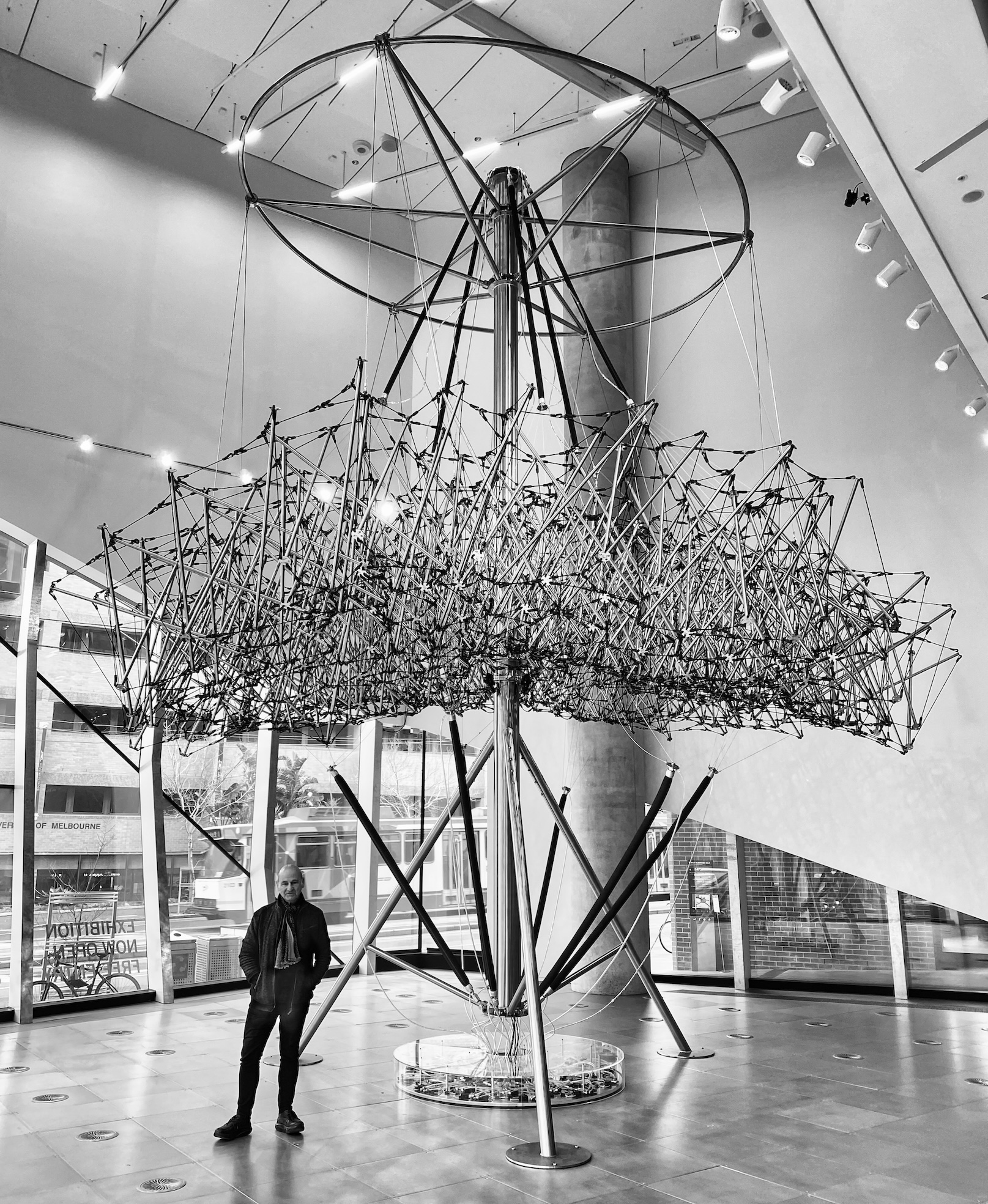
The Anthropomorphic Machine is an 8m high, 7m diameter interactive and performative robotic installation that alludes to human anatomy. It is engineered with pneumatically actuated rubber muscles, steel tendons, a deformable tensegrity skeletal structure, a circulatory system of compressed air, and a vision and computational system. It is a synthetic organisation allowing an emergence of form through an open system of collective behaviours of local human presence and actions. When under the tensegrity canopy, the vision system detects density, distribution and dynamics of people beneath the tensegrity canopy and the Anthropomorphic Machine responds with either undulating, swaying, pulsing or glitchy behaviour, generating a vocabulary of machine aliveness. Intermittent breathing behaviour is generated when no one is interacting. The Anthropomorphic Machine is not only a visual structure but also a sound machine. The choreography that is generated by its interaction composes the compressed air sounds and solenoid clicks, immersing the audience in its acoustical landscape. The Anthropomorphic Machine has hosted interactive performances with dance and musicians.
Credits
Creation and Performance: Stelarc
Design and prototyping team: Yuhan Hou and Haoyu Chen (LLDS)
Computer Vision: Quishi Zhou and Eduardo Velloso (Melbourne School of Engineering)
Electronical engineering: Eric Schoof (Melbourne School of Engineering)
Structure Engineer: Sascha Bohnenberger and Matthew Tam (Bollinger Grohmann)
Material testing: Steve Adams (Melbourne School of Engineering)
Fabricator: Callan Morgan, Pelican Studio
Website design: Florence tang and Melana Uceda
Science Gallery Team: Ryan Jefferies, Elsie Brokensha, Jack Farley, Niels Wouters
Photography: Alan Weedan
Robots used
A skeletal structure with a suspended tensegrity canopy than is animated by proximity, density and movements of visitors. It takes the form of an elevated assemblage of tubes and wires that contracts and expands in response to the movements of the artist.