In Embrace Angels robots dream of learning how to embrace. They are afraid that in our evermore technological and polorized world humans will forget. So they prepare to show future humans how to embrace, for inclusive planetary love. But can humans and robots truly embrace each other? Do we trust robots to embrace us? Do we accept sharing risk of discomfort or pain with robots? And in turn, do robots need consent? What experience and memories will humans and A.I. share? Who will shape these AI embraces? With what forms of AI categorization, control, code, protocols and hallucination? Why would we want to embrace robots? Can we imagine an intimate human-machine synthesizing embrace ritual? Embrace Angels explores a poetic, collective A.I. ritual for people and robots embracing – and for robots longing to learn to embrace each other. Embrace Angels investigates intimate relations, empathy and trust between humans, A.I. and robots. In rituals, performances and installations, robots are considered shells for A.I. models that meet with humans in cyborg relations: immersive choreographies of tender, dreamlike human–machine interaction. All bodies are rewired to challenge fluid boundaries between the vulnerable body, emotion and technology, self and other, and (dis)embodiment. Embrace Angels invites diverse audiences across cultural contexts, gender, ages and embodiment worldwide, to provoke dialogue about collective and individual embodied experience in coexistence.
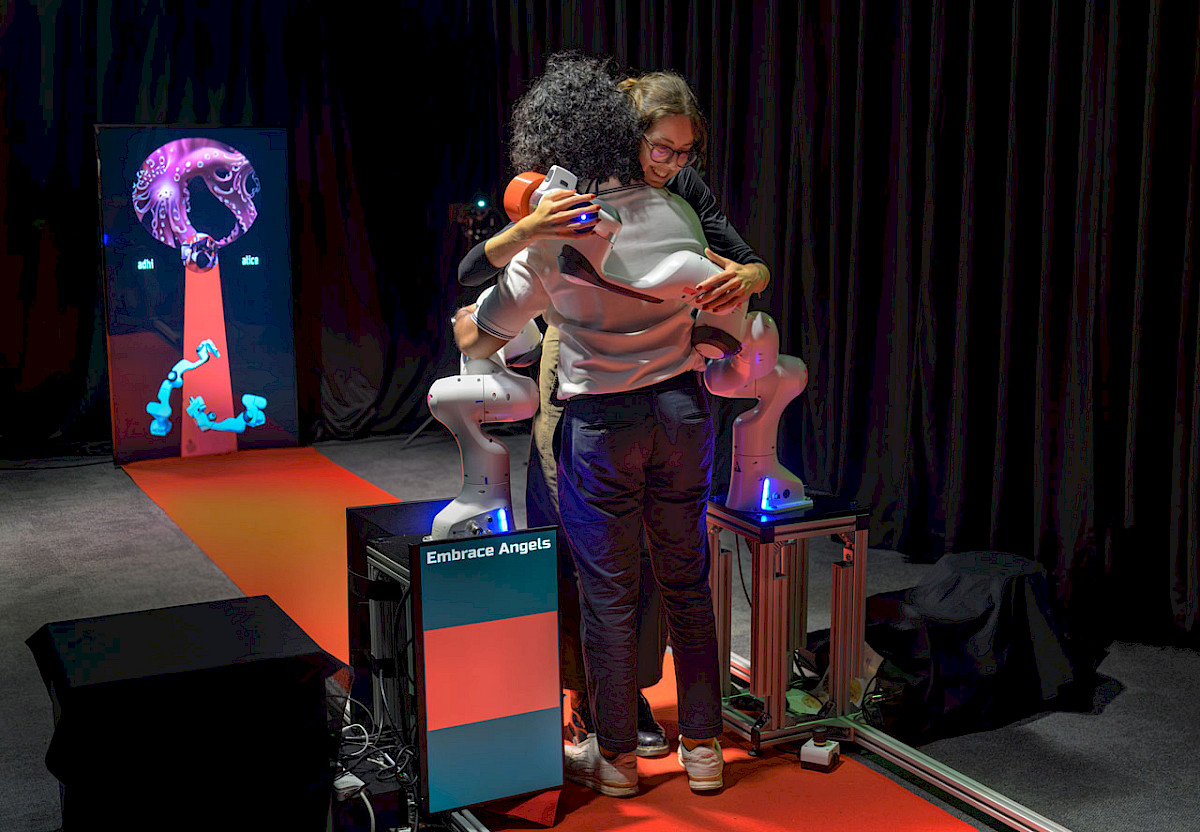
During performances the audience meets in a group embrace with the two robotic arms. Two participants walk slowly across the red carpet before embracing with the robotic arms, whose embracing movements are generated by the spectators in collaboration with an AI model. This AI model transforms the spectator’s stories and memories as prompts to generate unique robotic embracing gestures, through a process of categorizing and hallucination. Agency to share responsibility, to perform and to evoke meaning constantly shifts between participants, spectators, robots and AI. Once the participants let go, the robot arms continue to elegantly dance autonomously through the space where they had just been together with people, in replay of their memory. Their dramatic gestures – playing with human presence, absence and vulnerability – form a dynamic Embrace Sculpture, and an invitation to embrace once more.
Credits
Concept and creation: Karen Lancel, Hermen Maat
In collaboration with: Steven Benford, Gaby Weijers, Gabriella Giannachi, Rachel Garret, Gijs Huisman, A. Block, Sander Bos
Robots used
Two white robotic arms, clad in plastic and positioned on pedestals, flank both sides of a red carpet, ready to gently embrace anybody who stands between them.